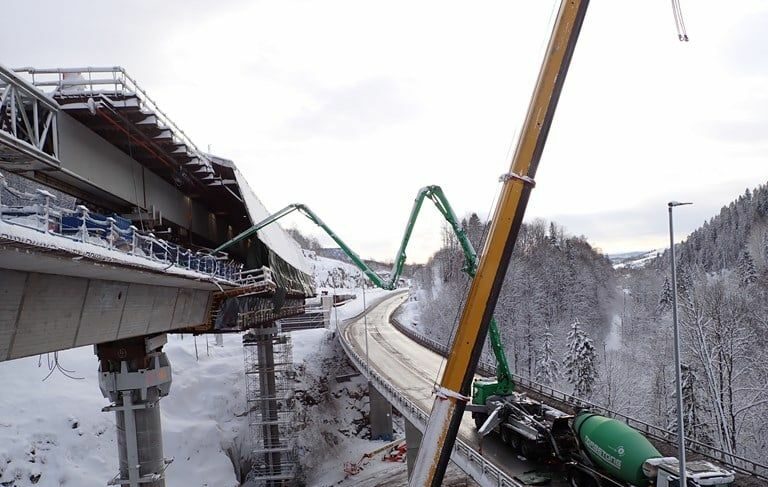
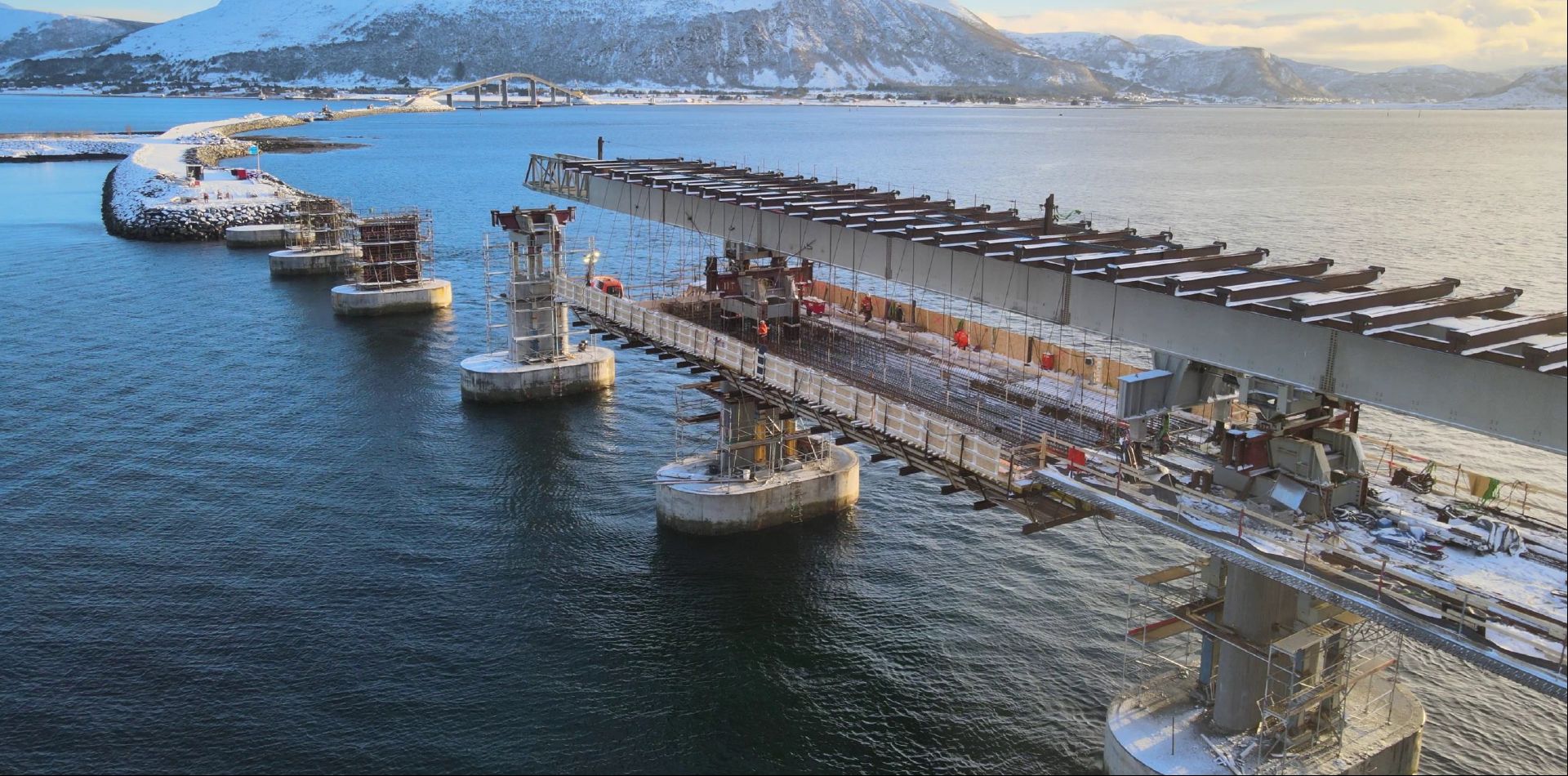
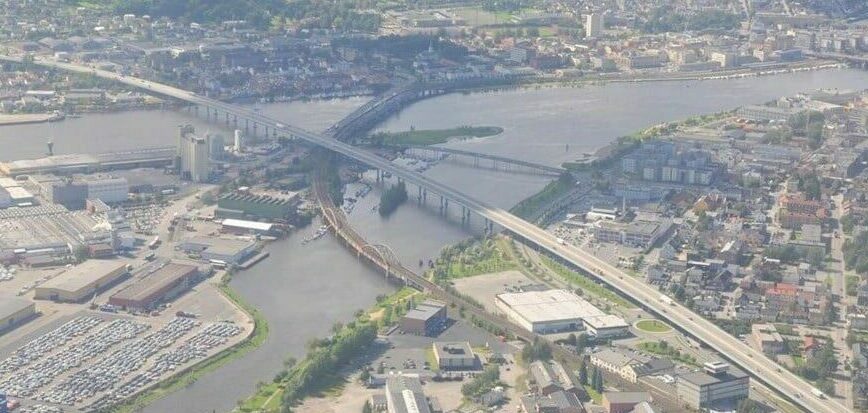
Strukturas – The Leading Bridge Building Equipment Supplier in Europe

Strukturas team congratulates founder Engineer Tore Gjølme on his 80th birthday

Movable Scaffolding Systems (MSS), Form Travellers, Launching Gantries, and full-service delivery for complex bridge decks.

Why Strukturas

For more than 30 years, Strukturas has helped contractors deliver over 300 bridges worldwide -safely, predictably, and on schedule. From concept engineering to dismantling, we supply bridge building equipment and the people, methods, and QA needed to execute critical-path concrete deck works for railway and highway viaducts, aqueducts, and long-span structures.

What sets us apart

  • Full portfolio: MSS (underslung & overhead), Form Travellers (FT), Segmental/Beam Launchers, Launching Gantries (LG).
  • End-to-end scope: design, engineering, fabrication, supply, rental, sale, sale-with-buyback, assembly, operation, dismantling planning, labour crew services.
  • Certified quality: Eurocode 3 / NS-EN 1993, EN-1090 (Execution Class II), steels Q235 / Q345.
  • Global footprint: European headquarters in Norway, with offices across Europe and Asia and agents in key markets.

What We Deliver: Systems That Fit Your Method

Movable Scaffolding Systems (MSS)

  • Configurations: Underslung and Overhead.
  • Use cases: In-situ bridge deck construction over water, traffic, and rail; constrained access; long approaches.
  • Engineering levers: span length, deck width, curvature radius, slope, load capacity, cycle time.
  • Features: Hydraulic systems, self-launching sequences, optimized transverse beams and supporting brackets.

Form Travellers (FT)

  • Variants: Overhead / underslung form travellers, segmental form travellers.
  • Method: Balanced cantilever for long spans, tall piers, and curved alignments.
  • Interfaces: Internal/external formwork, anchorage/brackets, predictable cycle control for cast in-situ boxes and U-shape aqueducts.

Launching Gantries & Beam Launchers

  • Segmental construction: Span-by-span or balanced methods for precast programs.
  • Beam launchers: Efficient placement for precast girder viaducts and approaches.

Where Our Equipment Excels

  • Viaduct concrete decks with repetitive spans.
  • Cast in-situ bridges where access is limited and logistics are constrained.
  • Full-span formwork scenarios that demand high productivity.
  • U-shape aqueducts and atypical cross-sections.
  • Over-water / over-rail alignments requiring self-launching and controlled possession windows.

End-to-End Services (Reducing Interfaces, Reducing Risk)

  1. Design & Engineering – method studies, preliminary sizing, detailed calculations, and constructability reviews.
  2. Fabrication & Supply – EN-1090 compliant manufacturing & QA, transport and pre-assembly planning.
  3. Commercial Modelsrental, sale, sale with buyback to match program horizons & redeployment plans.
  4. Assembly & Operation – site setup, commissioning, labour crews, supervision, cycle-time tuning.
  5. Dismantling Planning – safe-park strategies, retreat sequences, turnaround for next project.

Engineering & Technical Specifics

  • Geometry inputs: span length, deck width, curvature radius, slope.
  • Structural kit: internal/external formwork, supporting brackets, transverse beams tailored to box girder geometries.
  • Systems: synchronized hydraulic systems, controlled self-launching (underslung/overhead), defined load capacity envelopes.
  • Productivity: repeatable cycle time windows supported by crew models and shift patterns.

Standards, Certification & Materials

  • Eurocode 3 / NS-EN 1993 design basis.
  • EN-1090, Execution Class II fabrication control and traceability.
  • Steel grades: Q235 / Q345, selected for strength, weldability, and lifecycle performance.

Sustainability & Efficiency

  • Reuse, rental and sharing models to maximize equipment lifespan and minimize CO₂ footprint.
  • Efficient material usage via modular designs and redeployment planning.
  • Minimal environmental impact from self-launching methods that limit temporary works and ground disturbances.

Geographic Presence

A global supplier to contractors of railway and highway bridges, with project references across Europe, the Middle East, and worldwide.

Agents in: Azerbaijan, Bosnia and Herzegovina, Croatia, Czech Republic, France, Greece, Israel, Italy, Kazakhstan, Korea, Macedonia, Malaysia, Montenegro, Qatar, Romania, Singapore, Indonesia, Slovakia, Slovenia, Sweden, Taiwan, Turkmenistan, Turkey, Ukraine, United Kingdom.

Offices in: Norway (HQ), Austria, China, Estonia, Germany, Latvia, Lithuania, Poland, Portugal, Switzerland, Slovakia.

Track Record & Team

  • 30+ years of experience, 300+ bridges delivered.
  • International engineering bureau with several branches in Europe.
  • Proven references & case studies across geographies and delivery models.

Typical Engagement Flow

  1. Early inputs: alignment, span schedule, cross-sections, site constraints.
  2. Method screening: MSS vs. FT vs. LG vs. BL decision support with risk/constructability notes.
  3. Commercial fit: rental / sale / buyback with redeployment outlook.
  4. Execution plan: assembly, commissioning, cycle-time targets, QA plan, HSE envelope.
  5. Handover & dismantling: controlled retreat, asset preservation, documentation.

FAQ

Do you both rent and sell equipment?

Yes. We match rental, sale, or sale-with-buyback to program duration and your redeployment pipeline.

Can you operate the equipment with your crews?

Yes. We provide assembly, operation, and labour crew services, or we can supervise your crews.

What standards do you build to?

Design to Eurocode 3 / NS-EN 1993; fabrication to EN-1090 (Execution Class II) with documented QA; steel Q235/Q345.

Can you support over-water or over-rail projects?

Yes. We engineer self-launching MSS and method statements for constrained possessions and navigation windows.

Ready to build your next bridge more simple with worldwide bridge building equipment leaders? Talk to our engineers today and get your concept study started.

Follow us on social media for turnkey projects!

Choosing the Right Bridge Building Equipment Supplier for Your Project

Cross Tay Link Road bridge in Scotland Form Traveller

Choosing an equipment supplier is one of the most critical decisions in a bridge construction project, impacting everything from budget and safety to the final deadline. The right choice goes far beyond a simple price comparison. It involves a deep evaluation of a supplier’s capabilities and their ability to act as a true partner.

A top-tier supplier excels in three core areas: the quality of their equipment, the depth of their expertise, and the strength of their partnership. This guide breaks down what to look for in each of these essential pillars.

1. The Foundation: Equipment Fleet and Quality

The first step is to verify that the supplier has the right tools for the job and that those tools are of the highest quality.

The Essential Inventory

A specialized bridge-building supplier must offer a comprehensive range of machinery. This isn’t just about having one or two items; it’s about providing an integrated solution. Key categories include:

  • Heavy Lifting and Launching: This includes a variety of cranes (tower, mobile, gantry), launching girders for span-by-span construction, and specialized segment lifters.
  • Formwork Systems: A top supplier will offer advanced formwork, such as self-launching systems, that are essential for efficient on-site concrete casting.
  • Concrete and Foundation Machinery: This covers everything from concrete pumps and batching plants to pile drivers and excavation equipment.

Beyond the Inventory: Signs of Quality

Having the equipment is not enough. The quality and reliability of the fleet are what prevent costly downtime. Look for:

  • Modern, well-maintained fleet with clear maintenance records.
  • Safety and environmental compliance (e.g., ISO certifications).
  • Robust quality assurance including thorough inspections and material testing before equipment arrives on site.

2. The Differentiator: On-Site Technical Expertise

This is where a good supplier transforms into a great one. The support provided by their team is just as important as the machinery itself. On-site technical support is mission-critical for preventing delays and ensuring safety.

Correct Assembly and Commissioning

Specialized bridge equipment is not “plug-and-play.” An on-site technician from the supplier is the only person qualified to guarantee the equipment is assembled and calibrated according to the manufacturer’s exact specifications – a non-negotiable step for operational safety.

Immediate Troubleshooting to Minimize Downtime

When a key piece of equipment fails, the entire project can stop. The daily cost of a stalled infrastructure project can be astronomical. An on-site technician can often diagnose and fix an issue in hours, preventing a minor fault from turning into a multi-day delay.

Proactive Process Optimization

The best on-site support is proactive, not just reactive. An experienced technician can observe the workflow and suggest optimizations, such as a more efficient sequence for moving a formwork system. This expert guidance helps your team achieve maximum performance and can shorten the project timeline.

3. The Ultimate Goal: A True Strategic Partnership

Finally, the right supplier operates not as a temporary vendor, but as a long-term strategic partner invested in your project’s success. This value is seen in how they handle challenges and collaborate with your team.

Shared Risk and Innovative Solutions

A partner works with you during the planning stages, a principle known as Early Supplier Involvement (ESI). They use their experience to refine your equipment list, sometimes suggesting a different system that could save months from the schedule or improve safety. They share the responsibility of ensuring the project runs smoothly.

Unwavering Support in a Crisis

Projects rarely go exactly as planned. When challenges arise, a partner adapts with you. Their on-site team becomes an extension of your own, working to solve problems collaboratively. This immediate, unwavering support during a critical moment is the ultimate sign of a true partnership.

Long-Term Value

By working with an expert supplier, your own team’s skills grow. You establish a foundation of trust that makes future projects faster to plan and execute. The supplier becomes a go-to resource, providing a competitive advantage for your next tender.

Conclusion

The price on a quote reflects the cost of renting a machine. The true value, however, is found in the supplier’s ability to deliver reliable equipment, integrated expertise, and a genuine partnership that drives your project to a safe, on-time, and on-budget completion.

With more than 30 years of experience and over 300 bridge projects completed worldwide, Strukturas is uniquely positioned to meet these standards and help you complete your project in the best way possible.

Visit here to learn more.

Follow us on social media for turnkey projects!

Formwork, Mechanisation and Site Operations in Movable Scaffolding Systems

Formwork, Mechanisation and Site Operations in Movable Scaffolding Systems

Beyond the main steel structure, the formwork system and site operations are critical to the performance and cost-effectiveness of a Movable Scaffolding System.


Internal and external formwork: configuration and mechanisation

In box-girder decks, both internal and external formwork can be integrated into Overhead or Underslung MSS. The internal formwork configuration is governed by the internal geometry of the box, not by the MSS type, so the solutions are broadly similar.

Typical characteristics:

  • Normal panel length (both internal and external): 5–6 m.
  • Internal formwork systems are most efficient when they are hydraulically operated:
    • The system often consists of formwork panels 5–6 m long,
    • A rail system, and
    • A transport trolley that moves the folded internal formwork from span to span, powered hydraulically.

To ensure efficient operations, external and internal formwork panels are usually connected by threaded ties (e.g. Dywidag bars) passing through the deck webs.


Geometric conditions for using mechanised internal formwork

To make full use of mechanised internal formwork, some design decisions must be taken early in the bridge conception:

  • The internal diaphragm typically located above the pier axis should be designed with a central opening of adequate size.
  • This opening must allow the passage of the folded internal formwork on its transport trolley.
  • Traditional diaphragms with narrow man-access openings are not compatible with fully mechanised formwork.

In theory, diaphragms can be concreted in two stages to create a larger passage opening, but:

  • This usually requires extensive use of reinforcement couplers.
  • The resulting cost is high and usually not competitive.

A better solution is to adjust the slab and web thicknesses near the diaphragm, allowing the diaphragm to be sized with a sufficiently large opening for the internal formwork.


Crossfall, rotation of the section and pour sequence

Deck geometry in cross-section is also important for MSS optimisation:

  • Ideally, the deck cross-section should be geometrically constant, and variations in transverse slope should be obtained by rotating the whole cross-section.
  • If the top slab rotates with the change in crossfall while the bottom slab remains horizontal, the web height becomes variable.
  • This often forces the deck to be concreted in two stages, complicating both the formwork and the construction cycle.

Designing with MSS in mind means favouring simple, repeatable cross-sections and rotations.


Formwork surfaces: plywood vs steel

The most common formwork surface in MSS is:

  • Phenolic plywood, typically 21 mm thick.

Steel formwork skins are technically possible but usually less attractive in practice:

  • Rebuilding or adapting steel formwork for future projects is expensive.
  • With plywood:
    • The underlying steel structure is easily reused and modified for new projects.
    • Plywood sheets are screwed to timber sections bolted to the steel ribs and can be replaced if the number of spans is large or the surface wears out.

For typical deck lengths and project sizes, phenolic plywood offers the best balance of cost, flexibility and finish quality.


Handling of reinforcement with Overhead MSS

Overhead Movable Scaffolding Systems are often equipped with electric winches that allow the transport of pre-assembled reinforcement cages or large reinforcement modules.

Some winch systems use toothed racks and toothed wheels, which:

  • Ensure safe handling of loads on decks with longitudinal slopes.
  • Reduce manual handling and increase productivity on site.

MSS as machinery under the Machinery Directive

Due to the presence of movement (launching, formwork opening/closing, internal trolley, etc.), Movable Scaffolding Systems and Formtravellers fall under the definition of machines in the Machinery Directive.

This classification implies:

  • Detailed risk analyses must be carried out.
  • The design must consider the risk hierarchy defined in the Directive.
  • All user safety aspects (access, fall protection, emergency stops, guards, etc.) must be addressed systematically.

The result is equipment that is not only structurally safe, but also safe to operate.


Construction cycle, crew and launching speed

The typical operations when using an MSS include:

  • Opening the formwork
  • Launching the MSS to the next span
  • Closing and adjusting the formwork (including cambering)
  • Preparing for reinforcement
  • Concreting and prestressing

The crew size required depends on span length, deck width and cycle time, but typically:

  • An MSS requires a team of around 12–14 people to handle operations efficiently.

Regarding launching:

  • A typical launching speed is about 10 m per hour.
  • Higher launching speeds are technically possible, but:
    • The kinetic energy of the moving MSS increases with speed.
    • Any accidental contact with supports or obstacles leads to much higher impact forces.
    • The small time savings from faster launching rarely justify the increased risk.

In practice, controlled, moderate speed is the standard for safe MSS operations.


Pre-assembly, transport and bolted connections

During original manufacture:

  • MSS steel structures are usually partially pre-assembled in the workshop.
  • All components are marked with references to simplify correct on-site assembly.

For transport:

  • Parts are typically designed to fit into 40’ containers or onto standard TIR truck platforms.

On site, proper planning of assembly and dismantling is essential:

  • Correct definition of lifting points and sequences.
  • Control of the centre of gravity in each assembly phase.
  • Safe access for cranes and auxiliary equipment.

Bolted connections in MSS can be:

  • Friction (slip-critical) connections with pre-stressed bolts, or
  • Shear connections with non-pre-stressed bolts.

Each option has implications:

  • Friction connections require:
    • Calibrated torque wrenches,
    • Strict tightening procedures,
    • Non-reuse of pre-stressed bolts.
  • Shear connections are usually simpler and cheaper, and are commonly adopted when design allows it.

Design Criteria Document: the key to choosing the right MSS

To evaluate whether a given MSS is suitable for a specific deck, a Design Criteria Document is essential. This document must clearly define:

  • Loads from the fresh concrete
  • Safety factors
  • Wind speeds:
    • During launching
    • During concreting
    • Under storm conditions
  • Materials and steel grades
  • Maximum span and deck weight
  • Live loads and construction loads, among other parameters

The cost and site performance of an MSS depend heavily on these technical definitions. A well-prepared Design Criteria Document is the foundation for choosing or designing the right system for each project.

STRUKTURAS
WE MAKE IT SIMPLE!

If you have any questions or would like to discuss the possibilities for your bridge project, please get in touch with your local agent or our head office in Norway: CONTACTS  

Movable Scaffolding Systems (MSS): Types, Design Rules and Advantages

Movable scaffolding system

Movable Scaffolding Systems (MSS): Types, Design Rules and Advantages

Movable Scaffolding Systems (MSS) have become one of the most efficient solutions for constructing prestressed concrete bridge and viaduct decks on piers, span by span. They combine structural efficiency with repeatable construction cycles and long equipment life.

Types of Movable Scaffolding Systems

There are two main types of MSS:

  1. Overhead Movable Scaffolding Systems
    • The main steel structure is located above the deck.
    • The formwork is suspended from this upper structure.

  2. Underslung Movable Scaffolding Systems
    • The main structure is located under the deck.
    • The formwork rests on the lower structure.

From the point of view of weight and cost, both types are generally equivalent when designed for the same maximum span and deck weight per meter.

Site assembly: practical differences between Overhead and Underslung MSS

The main difference between the two systems appears during on-site assembly and dismantling:

  • Overhead MSS
    • Can typically be assembled and dismantled behind the abutments.
    • This can simplify logistics, especially where access under the bridge is difficult (rivers, railways, deep valleys, congested traffic).

  • Underslung MSS
    • Is usually assembled between the abutment and the first (or last) pier.
    • Dismantling is typically done between the abutment and the first/last pier as well, unless a phased construction of the abutment allows part of the MSS to pass through it.

These aspects are crucial when planning crane operations, temporary works, and site sequencing.

Structural performance and deformability limits

In the structural design of MSS, deformations are carefully controlled:

  • For the overall MSS span, a maximum total deformation of L/400 is usually adopted, where L is the span of the MSS (axis-to-axis distance of its supports).
  • For local elements, such as individual formwork profiles, a typical limit is L/250 for the relevant element span.

This control ensures that the final deck geometry (including camber and alignment) stays within strict tolerances and that formwork reactions are close to those assumed in design.

Design codes and fabrication standards

The steel structure of a Movable Scaffolding System is usually designed and manufactured under well-defined standards:

  • Eurocode is used for the assessment of structural safety.
  • EN 1090 governs the quality control of steel fabrication.

In practice, MSS structures are also:

  • Modelled in 3D or represented in detailed 2D drawings.
  • Supplied with precise weights for all components, essential for planning lifting and assembly operations safely.

General advantages of MSS solutions

Key advantages of Movable Scaffolding Systems include:

  • Optimized material consumption in the bridge deck (concrete, reinforcement and prestressing) due to favorable construction load conditions.
  • Environmental benefits: MSS equipment typically has a useful life exceeding 50 years, making it reusable on many projects.
  • Low operating energy consumption compared to many alternative heavy construction methods.
  • Independence from ground bearing capacity and terrain relief, since the system is supported by the piers.

These features explain why MSS is often the preferred solution for repetitive spans on viaducts and long elevated structures.

Longitudinal slopes and safety in MSS launching

In theoretical terms, there is no strict limit on longitudinal slope for decks built with MSS. The longitudinal launching system is:

  • Hydraulically driven, and
  • Equipped with a mechanical brake, typically a pin system, that holds the MSS safely in place when the drive cylinder is retracted.

In addition, the hydraulic cylinders used for MSS launching are usually equipped with safety valves:

  • In case of a hydraulic pipe rupture, these valves block the oil inside the cylinder.
  • This stops unintentional movement and prevents uncontrolled displacement of the MSS.

These safety and control systems allow MSS to be used safely even on decks with significant longitudinal slopes.

STRUKTURAS
WE MAKE IT SIMPLE!

If you have any questions or would like to discuss the possibilities for your bridge project, please get in touch with your local agent or our head office in Norway: CONTACTS  

Modern methods for constructing prestressed concrete bridge decks and viaducts

Strukturas Underslung MSS

Modern methods for constructing prestressed concrete bridge decks and viaducts

The construction of prestressed reinforced concrete bridge decks and viaducts is currently dominated by a set of well-established methods and specialist equipment. Broadly, these solutions can be divided into in situ concrete bridges and prefabricated bridges, each with its own structural and construction logic.

Among in situ methods, three types of equipment are particularly widespread today:

  • Ground-supported falsework
  • Pier-supported falsework
  • Incremental Launching equipment


Pier-supported falsework: Formtravellers (FT) and Movable Scaffolding Systems (MSS)

Pier-supported falsework is especially relevant when the site conditions make ground-supported systems impractical.

Two types of equipment are currently dominant:

  • Formtravellers (FT)
  • Movable Scaffolding Systems (MSS)


They serve different structural solutions:

  • Formtravellers are used for decks constructed by the cantilever method, typically segment by segment, balanced around piers.
  • Movable Scaffolding Systems are used for decks designed as continuous concrete beams supported on the columns, where each span is concreted in its final position.


In both cases, the deck is concreted in sections:

  • With Formtravellers, typical segment lengths are up to 5 m, and in special cases can reach 10 m.
  • With Movable Scaffolding Systems, the deck is cast span by span. Construction joints are usually placed at about 1/5 of the span length, where bending moments are close to zero.


Incremental Launching Method (ILM)

The Incremental Launching Method is used for the construction of continuous decks in concrete, steel or composite (steel–concrete) solutions. The deck is prefabricated in sections behind an abutment and then pushed longitudinally over the piers using hydraulic cylinders.

Structurally, ILM is also suited to beam-type decks, which naturally raises the comparison with MSS.


MSS vs Incremental Launching: key differences

Both MSS and ILM are used to build continuous beam decks, but the way the deck is formed and loaded during construction is very different:

  • In Incremental Launching:
    • The deck is prefabricated by sections behind the abutment.
    • The entire deck is pushed over the top of the columns with hydraulic cylinders.
    • During construction, any given section of the deck may be subjected to very high stresses, often close to or higher than those in service.


  • In Movable Scaffolding Systems:
    • The MSS incorporates the full formwork and support structure.
    • Each deck span is concreted directly in its final position, supported by the system and the piers.
    • The forces in the deck and columns during construction are of the same order of magnitude as in the final service stage.


Material efficiency and structural design implications

From a structural design perspective, Movable Scaffolding Systems typically allow the minimum consumption of concrete, reinforcement and prestressing steel. The reason is simple:

  • With MSS, construction loads resemble service loads, so the deck does not need to be over-dimensioned for extreme temporary load cases.
  • With ILM, the launching process causes unfavourable and often critical stress states along the deck during construction, which must be considered in design.

There are also geometric and project-level advantages that favour MSS in many cases:

  • MSS allows decks with variable radii both in plan and elevation, adapting well to complex motorway or railway alignments.
  • MSS solutions are independent of ground bearing capacity and relief, since they are supported on the piers rather than the ground.


For designers and contractors, this often translates into more flexible geometry, leaner structures and fewer constraints from site ground conditions when MSS is used.

STRUKTURAS
WE MAKE IT SIMPLE!

If you have any questions or would like to discuss the possibilities for your bridge project, please get in touch with your local agent or our head office in Norway: CONTACTS  

How MSS (Movable Scaffolding System) Revolutionizes Construction Efficiency

Span by span bridge demolition using MSS

In the world of large-scale infrastructure, speed, safety, and efficiency are paramount. For the construction of long, multi-span viaducts, one technology stands out for its ability to revolutionize the entire process: the Movable Scaffolding System (MSS).

An MSS is essentially a “bridge factory on wheels.” It’s a self-contained, self-launching system that allows for entire bridge spans to be cast in place without relying on traditional, ground-based scaffolding. By industrializing the construction site, this technology enables projects to be completed faster, more safely, and with a higher degree of quality control than ever before.

Key features include:

  • Full-Span Construction: An entire bridge span (the section between two piers) is cast in a single, continuous operation.
  • Self-Launching: After a span is complete, the system hydraulically moves itself forward to the next set of piers to repeat the cycle.
  • Two Main Types: Systems are either Overhead (where the main support structure is above the bridge deck) or Underslung (where it is positioned below).

The On-Site Construction Cycle: A Step-by-Step Look

Unlike a generic project plan, the true efficiency of an MSS is in its physical, on-site, and highly repetitive weekly cycle.

  1. Positioning the System: The MSS is launched forward from the completed section of the bridge and securely positioned onto the next set of piers.
  2. Formwork and Reinforcement: The formwork (the mold for the concrete) is set up, and the steel reinforcement cage is assembled inside it. This is all done on the stable platform of the MSS.
  3. Concrete Pour and Curing: The full bridge span is cast with concrete in one continuous pour. The concrete is then left to cure and gain the required strength, supported entirely by the MSS.
  4. Post-Tensioning: Once cured, high-strength steel tendons are run through the concrete and tensioned. This process, known as post-tensioning, gives the bridge span its structural integrity.
  5. Launching Forward: The formwork is lowered, and the entire MSS system launches itself forward to the next piers to begin the cycle all over again.

The Core Advantages: How MSS Boosts Efficiency

The primary reason for using an MSS is to achieve a level of efficiency that is impossible with traditional methods.

  • Unmatched Speed: The repetitive, industrialized cycle allows a well-managed team to complete a full 40–50 meter span every 7 to 10 days. This predictable speed is critical for meeting tight project deadlines.
  • Significant Cost Savings: By eliminating the need for massive, ground-up scaffolding for every span, an MSS dramatically reduces material and labor costs. Its high level of mechanization also means smaller, more specialized crews are needed.
  • Enhanced Safety and Quality: The MSS provides a single, integrated, and stable working platform. This controlled environment significantly improves worker safety compared to scattered scaffolding and leads to a more consistent, higher-quality concrete structure.
  • Minimal Ground-Level Impact: As a “top-down” construction method, an MSS has a very small footprint on the ground. This is a crucial advantage when building over water, sensitive ecosystems, or active roadways and railways.

Ideal Applications: When is MSS the Best Choice?

While powerful, an MSS is a specialized piece of equipment. It is the most suitable and efficient method for projects with the following characteristics:

  • Long, Multi-Span Viaducts: The system’s main advantage is its repetitive cycle, making it perfect for bridges and viaducts with many similar spans.
  • Projects in Difficult Terrain: It is the ideal solution for building bridges high over deep valleys, wide rivers, or other areas where building scaffolding from the ground would be impractical or impossible.
  • Construction Over Active Areas: Its ability to work from above makes it the preferred choice for building over busy highways, railways, or other infrastructure that cannot be shut down.

How MSS Technology is Shaping the Future of Bridge Construction

MSS technology is a key enabler for the rapid and sustainable development of the long-span viaducts and highway networks that modern economies demand. By turning the construction site into a mobile production line, it is pushing the industry toward a future that is faster, safer, less disruptive, and more integrated with digital tools like Building Information Modeling (BIM).

The repetitive cycle also opens the door for future automation, further solidifying the MSS as a cornerstone of modern bridge engineering.

Strukturas has a perfect team for your bridge. If you wish to use most benefits of MSS – let’s chat.

STRUKTURAS
WE MAKE IT SIMPLE! 
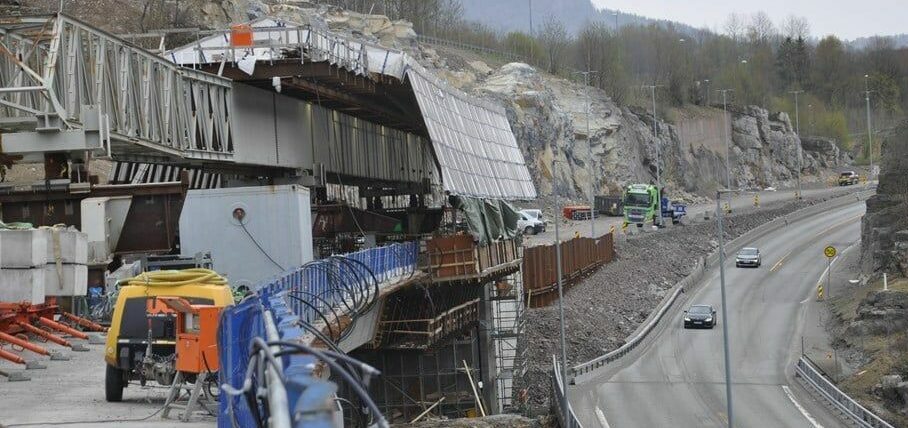
Construction Methods for Prestressed Concrete Bridge Decks and the Role of Form travellers

Form Traveller Strukturas

Construction Methods for Prestressed Concrete Bridge Decks and the Role of Formtravellers

The construction of prestressed reinforced concrete bridge decks and viaducts can generally be divided into two large families:

  • In situ concrete bridges, where the deck is cast on site.
  • Prefabricated bridges, where large structural elements are manufactured in a factory environment and later assembled on site.

Within the in situ family, several types of equipment are commonly used for the construction of prestressed concrete decks. Today, the main ones are:

  • Ground-supported falsework
  • Pier-supported falsework
  • Incremental Launching systems

Among these, pier-supported falsework plays a key role when ground access is difficult (rivers, valleys, railways) or when ground-supported systems would be uneconomical or unsafe.


Pier-supported falsework: Formtravellers and Movable Scaffolding Systems

The most widely used pier-supported systems are:

  • Formtravellers
  • Movable Scaffolding Systems

These two families serve different structural solutions:

  • Formtravellers are used to construct bridge and viaduct decks by the cantilever method. The deck is built in successive segments projecting from a pier, usually in symmetric pairs, one on each side of the pier axis.
  • Movable Scaffolding Systems are used for bridge and viaduct decks designed as concrete beams supported on columns, where spans are cast in situ with support on the piers.

In both cases, the deck is constructed in sections:

  • With Formtravellers, the deck is built in segments, typically up to 5 m long. In some special cases, segment length can be increased up to 10 m.
  • With Formtraveller Systems, the deck is also constructed in sections, but typically one full span at a time. Concreting joints are usually placed at approximately 1/5 of the span length, where the bending moment is close to zero.

Types of Formtraveller 

Formtraveller have evolved into several specialised configurations to respond to different types of structures:

  1. Overhead Formtraveller
    • The main structure is located above the deck.
    • The formwork is suspended from this upper structure.
  2. Underslung Formtraveller
    • The main structure is located under the deck.
    • The formwork rests on the lower structure.

  3. Arch Formtraveller
    • A specialised solution developed to allow the casting of concrete arch segments.

  4. Wing Formtraveller
    • Typically used to cast deck wings, either for composite decks or for fully concrete decks.

Advantages of Formtraveller 

Formtraveller offer several important advantages for the construction of bridges and viaducts:

  • They allow large spans to be cast in situ by the cantilever method, segment by segment.
  • Segments are usually cast in symmetric pairs from each column, which balances cantilever moments and is structurally efficient.
  • They are environmentally friendly, as their useful life can exceed 50 years, allowing reuse on many projects.
  • Their energy consumption during operation is generally low compared to alternative heavy construction methods.

Overhead vs Underslung Formtraveller: how to choose?

  • For the same segment length and segment weight, the Overhead Formtraveller System is usually lighter and cheaper than the Underslung solution.

This makes the overhead configuration particularly attractive.

STRUKTURAS
WE MAKE IT SIMPLE!

If you have any questions or would like to discuss the possibilities for your bridge project, please get in touch with your local agent or our head office in Norway: CONTACTS  

Structural Design, Geometry and Safety of Formtraveller 

Underslung Form Traveller Ariari

Structural Design, Geometry and Safety of Formtraveller 

Formtraveller are complex steel structures that support fresh concrete, reinforcement, construction live loads and self-weight during both casting and launching stages. Their structural design must comply with strict criteria for deformation, safety and geometric compatibility with the bridge deck.


Deformation limits and design codes

During the design stage, maximum deformability is carefully controlled:

  • For the main structure of the Formtraveller, a maximum global deformation of L/400 is normally considered, where L is the span of the main structure.
  • For local elements, such as individual formwork profiles, the usual limit is L/250 for the span of the profile in question.

These limits ensure proper deck geometry, correct camber and acceptable stress distributions in both the temporary equipment and the permanent structure.

Regarding design standards:

  • Eurocode is typically used for the assessment of structural safety.
  • EN 1090 is used for quality control of the fabrication of the steel structure.

Connections, anchorage and checks on the permanent structure

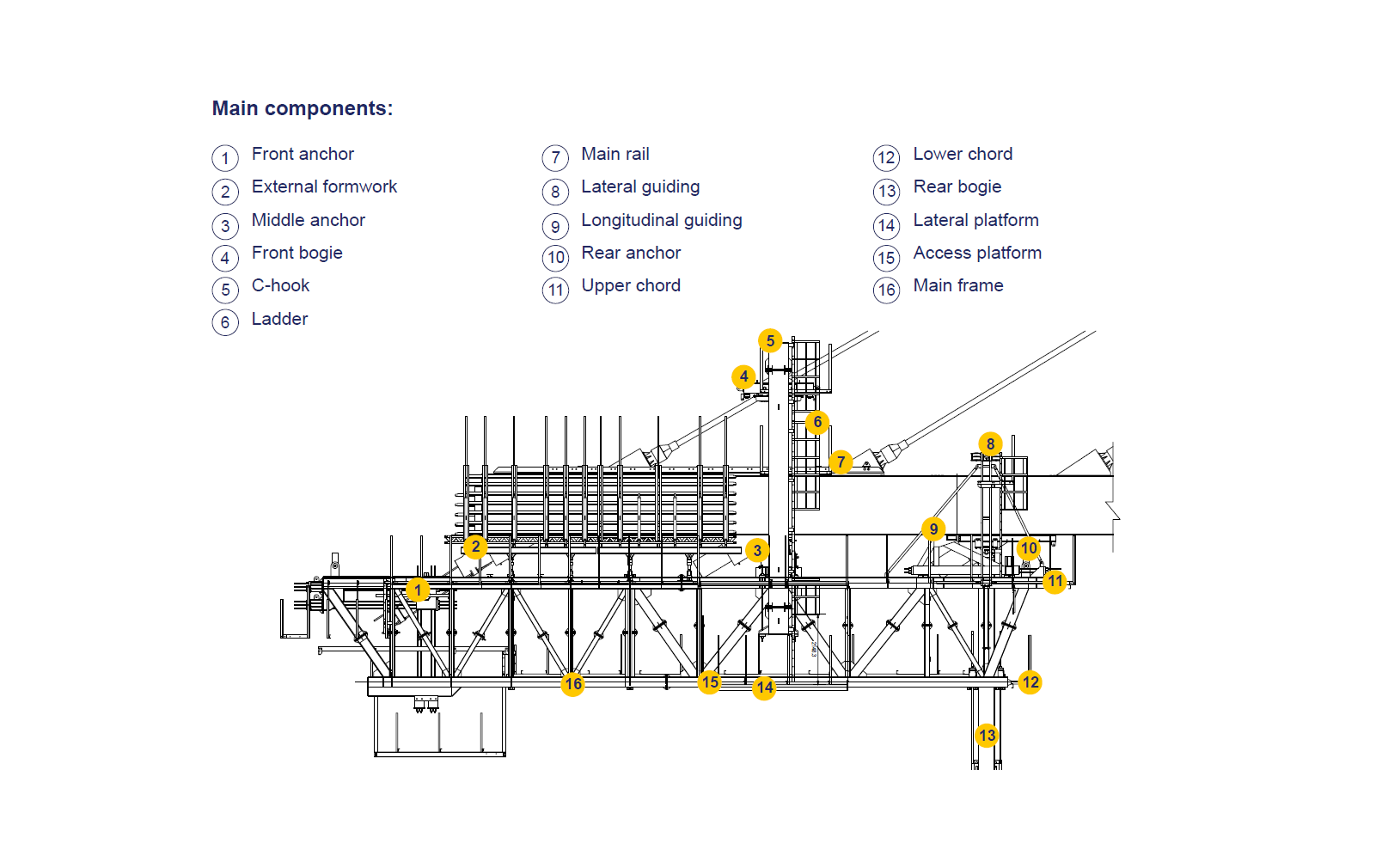
Formtravellers are connected to the concrete deck using anchors made of threaded bars, which pass through blockouts in the bottom and top slabs. These anchors transmit:

  • Vertical loads
  • Stability-related forces during both casting and launching

Before casting a segment, it is essential that the reactions from the Formtraveller (in both casting and launching configurations) are submitted to the bridge designer. The designer must:

  • Verify the columns and
  • Check the deck section
    for all relevant construction-stage load combinations.

These checks are critical, since cantilever construction can produce more severe stresses in some sections during construction than in the final service condition.

Geometric conditions: diaphragms, web spacing and internal formwork

The geometric conception of the deck has a strong influence on the practicality of using Formtraveller, particularly when internal formwork is present.

Key aspects include:

  • Position of diaphragms
    • To allow mechanised internal formwork to be launched from segment to segment, the internal diaphragm should be placed at the rear of the segment. Same is applied to the external diaphragms and external formwork.
    • If diaphragms are located near the front of the segment, the internal formwork behind them cannot be launched forward and must be dismantled or lowered, which is inefficient and time-consuming.
    • Concreting diaphragms in two stages to create a passage for the internal formwork may be possible in some cases, but this is a decision for the bridge designer and may complicate reinforcement arrangement.

  • Distance between deck webs
    • For optimal use of Formtraveller formwork, it is very important that the distance between the deck webs remains constant along the deck.
    • Constant web spacing facilitates repetitive, standardised internal and external formwork and simplifies tie arrangements.

Longitudinal slope and launching safety

From a theoretical point of view, there is no absolute limit on longitudinal slope for decks built with Formtraveller Systems. However:

  • When the deck longitudinal slope is large, some modifications are needed:
    • The Formtraveller must be able to stay horizontal during casting, to ensure correct concrete distribution and work conditions.
    • During launching, the system must be able to follow the deck slope.
  • A braking device must be included, ensuring that the Formtraveller remains safely in position on top of the rails during launching, especially on significant slopes.

The hydraulic cylinders used for longitudinal launching typically include a safety valve:

  • In the event of a hydraulic pipe rupture, this valve blocks the oil inside the cylinder.
  • This instantly stops the movement and prevents uncontrolled displacement of the Formtraveller.

Classification under the Machinery Directive

Because Formtraveller involve movement (launching, formwork opening/closing, internal formwork repositioning), they fall under the definition of machinery in the Machinery Directive.

This classification requires:

  • Detailed risk analyses, covering all operating modes.
  • Application of the risk reduction hierarchy defined in the Directive.
  • Design solutions that address user safety in a systematic way (access, fall protection, guarding, emergency stopping, etc.).

In practice, a compliant Formtraveller is not only structurally sound, but also engineered as a machine with safety-integrated design.

STRUKTURAS
WE MAKE IT SIMPLE!
If you have any questions or would like to discuss the possibilities for your bridge project, please get in touch with your local agent or our head office in Norway: CONTACTS  

Formwork, Operations and Logistics in Formtraveller

Formwork, Operations and Logistics in Formtraveller 

The efficiency of a Formtraveller depends heavily on how the formwork is designed and handled, and how site operations and logistics are planned. This includes panel dimensions, formwork surfaces, internal formwork launching, crew size, launching speed and workshop pre-assembly.


Internal and external formwork: configuration and handling

In typical applications, the external and internal formwork panels have a length of about 5.8 m, assuming a maximum segment length of 5 m in the concrete deck.

Internal and external panels are connected using threaded ties, such as Dywidag bars, passing through the deck webs. This creates a closed, stable formwork box that can carry fresh concrete and construction loads.

The internal formwork in Formtravellers is usually launched manually from one segment to the next:

  • Chain tackles are commonly used to move the internal formwork along rails.
  • Hydraulic cylinders can also be adopted, but the standard solution in many projects remains manual.
  • The rails on which the internal formwork rests are launched together with the main structure of the Formtraveller.

As mentioned earlier, the position of internal diaphragms must allow the internal formwork to pass. If diaphragms are too close to the front of the segment, the internal formwork may need to be dismantled behind the diaphragm.


Formwork surfaces and materials

The most common formwork surface used in Formtraveller Systems is:

  • Phenolic plywood, usually 21 mm thick.

Steel formwork surfaces are technically possible but rarely preferred:

  • Rebuilding steel formwork for future projects is costly.
  • For typical segment lengths and project sizes, plywood offers a better economic balance.

The usual arrangement is:

  • Plywood sheets are screwed to timber sections.
  • Timber sections are bolted to the steel ribs of the formwork structure.
  • Parts of the internal and external web formwork are often made using wooden beams.

If the number of segments is very high, the phenolic plywood can be replaced during the life of the Formtraveller, while the underlying steel structure remains reusable.


Handling reinforcement: limits and special solutions

As a rule:

  • Overhead Formtraveller do not normally allow the transport of pre-assembled reinforcement cages on the system itself.

However, in some specific projects where:

  • The deck webs are vertical or nearly vertical, and
  • Pre-assembled web rebar panels are desired,

it may be possible to develop special transport rails integrated into the Formtraveller. In such cases:

  • A crane installs the pre-assembled web reinforcement panel.
  • The load is then transferred from the crane to the special rails of the Formtraveller.

These are project-specific solutions, not the standard configuration.


Crew size, launching speed and construction cycle

To operate a Formtraveller– including:

  • Opening the formwork
  • Launching from one segment to the next
  • Closing the formwork
  • Introducing camber
  • Preparing the formwork for reinforcement
  • Concreting the segment

– a dedicated crew is required. 

The exact crew size depends on the segment weight, deck width and the target construction cycle, but in general:

  • A team of 8 to 10 people per pair of Formtravellers is typical.

Regarding relocation speed:

  • The normal launching speed of a Formtraveller is around 10 m per hour.
  • Increasing the launching speed does not make practical sense, since the maximum segment length is only about 5 m. The marginal time savings are minimal, and the risks associated with higher movement speeds increase.

The typical construction cycle for a pair of segments using Formtravellers is approximately:

  • 1 week per pair of segments,
    assuming standard times for reinforcement assembly, prestressing operations, concrete curing, and formwork operations.

Workshop pre-assembly, transport and on-site planning

During the original manufacture of a Formtraveller System:

  • The steel structure is usually partially pre-assembled in the workshop.
  • All components are marked with references, indicating their position in the final assembly.

For transport:

  • Parts are designed to fit in 40-foot containers or on TIR truck platforms.

On site, careful planning of assembly and dismantling is essential:

  • Correct definition of lifting points for sub-assemblies.
  • Ensuring that the centre of gravity of each assembly stage remains within safe limits.
  • Guaranteeing suitable access for cranes and transport equipment.

Accurate weights of all parts must be known:

  • Typically derived from 3D models or detailed 2D drawings.
  • If there is any uncertainty, scales can be used to confirm the component weights.

Design Criteria Document: selecting the right Formtraveller 

To evaluate whether a given Formtraveller is suitable for a specific bridge deck, it is essential to prepare a Design Criteria Document. This document must clearly define at least:

  • Loads from the concrete segments and launching situation
  • Safety factors
  • Wind speeds:
    • During launching
    • During concreting
    • Under storm conditions
  • Materials and steel grades
  • Maximum span
  • Live loads and other construction loads

The cost and site performance of a Formtraveller depend strongly on these definitions. A well-prepared Design Criteria Document is therefore the key technical basis for:

  • Deciding whether an existing system can be reused or adapted, or
  • Designing a new system optimised for the specific project.

In most successful cantilever projects, the Formtraveller is not an afterthought but an integral part of the initial design strategy for the bridge.

STRUKTURAS
WE MAKE IT SIMPLE! 
Form Traveller vs. Movable Scaffolding System (MSS): Which Bridge Construction Method Is Right for Your bridge?

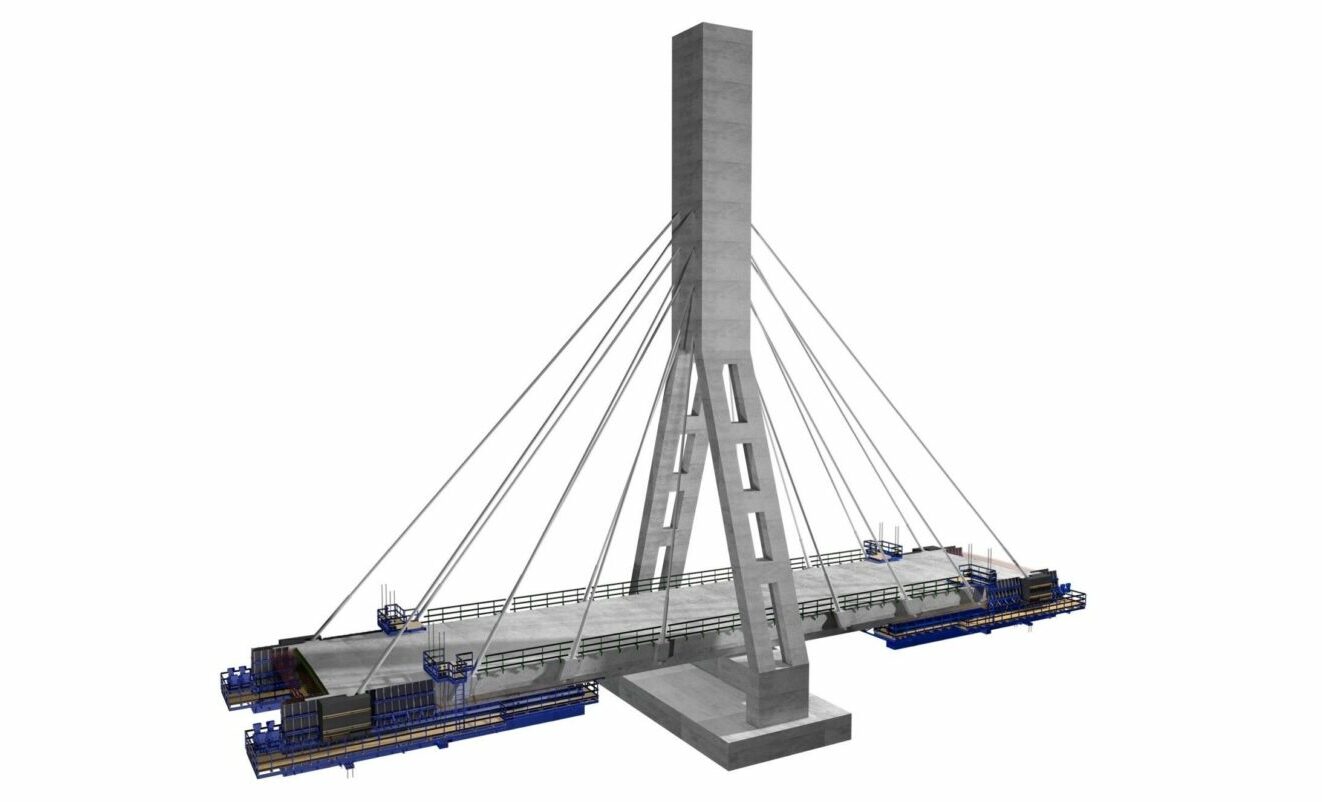
Anna Jagiellon Bridge, Warsaw, Poland construction using Form Travellers, Overheard Movable Scaffolding System and Wing Form Travellers

Bridge construction has evolved dramatically over the past few decades. Among the most efficient technologies for cast-in-situ segmental bridge construction are Form Travellers (FTs) and Movable Scaffolding Systems (MSS).

Both systems enable builders to construct long-span bridges without extensive falsework or ground support. However, each has unique advantages, limitations, and ideal use cases. In this article, we’ll explore the key differences between Form Travellers and Movable Scaffolding Systems, helping you determine which is best suited for your next bridge project.

What Is a Form Traveller (FT)?

A Form Traveller is a specialized structural system used to cast bridge segments in place — typically in balanced cantilever construction. It allows engineers to build a bridge span segment by segment, extending out from a pier on both sides to maintain equilibrium.

Types of Form Travellers

There are two main types:

  • Overhead Form Traveller: Supported from above the deck, ideal for deep valleys or bridges over water.
  • Underslung Form Traveller: Suspended below the deck, used when there is sufficient space beneath the structure.

How It Works

The traveller is positioned at the end of the previously cast segment. After reinforcement, formwork, and concreting are completed, the new segment is cured and post-tensioned. The form traveller is then moved forward to the next position — repeating the cycle until the span is complete.

Advantages of Form Travellers

1. Minimal Ground Interference

Form travellers are entirely supported by the completed bridge structure itself, eliminating the need for ground-based falsework or scaffolding.

This makes them ideal for bridge construction over challenging terrains such as rivers, deep valleys, highways, and railways, where erecting temporary supports would be costly, dangerous, or even impossible.

By suspending operations above ground, contractors can work safely and continuously without disrupting the environment or traffic below.

2. High Precision and Geometric Control

Each segment constructed using a form traveller is aligned directly from the previous one, ensuring millimeter-level accuracy in deck geometry, slope, and alignment.

This precision is particularly important for long-span balanced cantilever bridges, where even small cumulative errors could result in significant misalignment.

Modern form traveller systems are equipped with hydraulic adjustment and monitoring systems, allowing engineers to maintain perfect geometry throughout construction.

3. Adaptability to Complex Bridge Designs

One of the strongest advantages of form travellers is their flexibility. They can easily adapt to variable spans, curved alignments, varying deck depths, and asymmetric cross-sections – features commonly found in modern architectural bridge designs.

Because the system is modular, it can be adjusted or modified for different segment lengths or shapes, making it suitable for architecturally complex or topographically challenging bridge projects.

4. Reduced Environmental Impact

Since form travellers do not require temporary supports or extensive site preparation, they significantly minimize ecological disturbance.

There is no need for foundation works in rivers or forests, which helps preserve wildlife habitats and natural landscapes.

This makes the method particularly favored in environmentally sensitive areas where traditional falsework would not be permitted.

5. Safety and Accessibility

Form travellers provide a stable and controlled working platform directly attached to the bridge, reducing risks associated with working at height or on unstable ground.

Engineers and workers can perform concreting, post-tensioning, and inspection operations in a secure environment with integrated walkways and access systems.

This contributes to improved safety performance and reduced downtime due to weather or ground conditions.

6. Long-Term Reusability

A well-designed form traveller can be reused across multiple spans or projects, which makes it a cost-efficient investment for companies specializing in segmental bridge construction.

The modular steel structure allows for quick assembly, disassembly, and transportation between job sites, enhancing operational efficiency over time.

Limitations of Form Travellers

1. Slower Construction Rate Compared to MSS

While form travellers offer exceptional flexibility, their cycle time per segment is typically longer than that of movable scaffolding systems (MSS).

Each segment must be individually set, reinforced, concreted, cured, and post-tensioned before the traveller can be advanced to the next position.

This makes the process less efficient for long, repetitive viaducts where uniform spans could be cast faster using span-by-span methods.

2. Higher Skill, Labor, and Equipment Requirements

Operating a form traveller demands specialized engineering expertise.

Precise alignment, load balancing, and structural monitoring are critical to ensure safety and quality.

Crews must be experienced in post-tensioning, segmental casting, and geometry control, which increases labor costs and training requirements.

Additionally, form travellers rely on advanced hydraulic and lifting equipment, adding to both capital and maintenance expenses.

3. Not Ideal for Low-Level or Easily Accessible Bridges

For bridges constructed close to the ground or in areas with easy site access, using form travellers is often unnecessary and uneconomical.

In such cases, conventional scaffolding or movable scaffolding systems (MSS) offer faster setup, simpler logistics, and lower overall costs.

Form travellers are most cost-effective when ground support is impractical or when the bridge spans are too long for traditional falsework methods.

4. Higher Initial Setup Time

The initial assembly, calibration, and load testing of a form traveller require considerable preparation.

Before casting begins, the system must be precisely aligned with the pier segment, balance loads must be verified, and safety systems must be tested.

While this setup ensures accuracy and safety, it also extends the pre-construction phase, which can affect project timelines.

5. Weight and Stability Constraints

Form travellers carry significant loads from both the fresh concrete and the equipment.

As a result, the pier and segment structure must be strong enough to support these loads during cantilevering.

For lighter or slender piers, additional temporary stabilization may be necessary — slightly reducing the overall efficiency advantage.

What Is a Movable Scaffolding System (MSS)?

A Movable Scaffolding System, often referred to as a Launching Girder, is an advanced construction method used for span-by-span cast-in-situ bridges. Instead of building segments one by one from a pier, the MSS supports the entire span during concreting.

Types of MSS

  • Overhead MSS: The truss structure is positioned above the bridge deck.
  • Underslung MSS: The truss structure is below the deck, used when overhead clearance is limited.

How It Works

The MSS is positioned between two piers. Once the formwork and reinforcement are ready, the entire span is cast in place. After curing and post-tensioning, the system is moved (or “launched”) to the next span. This method is ideal for repetitive spans of similar geometry.

Advantages of Movable Scaffolding Systems (MSS)

1. High Construction Speed

The Movable Scaffolding System (MSS) is designed for rapid, span-by-span construction.

Unlike form travellers that cast one short segment at a time, the MSS supports and casts an entire bridge span in a single cycle. Once the concrete has gained sufficient strength and post-tensioning is complete, the entire system is “launched” or moved forward to the next span.

This cyclical workflow significantly reduces construction time, making the MSS ideal for large-scale infrastructure projects such as expressways, metro viaducts, and high-speed rail bridges where many similar spans are required.

2. Efficiency for Repetitive and Standardized Designs

MSS technology is most efficient in projects that have repetitive span lengths and uniform geometry.

When bridge spans, pier heights, and deck shapes remain consistent, the system can operate in a steady rhythm that minimizes manual adjustments.

This efficiency not only saves time but also reduces material waste and formwork errors.

For long viaducts or elevated highways with repetitive spans, MSS is often the most cost-effective construction method available.

3. Excellent Safety and Working Platform

One of the major advantages of MSS is that it provides a secure and self-contained working platform.

Workers can complete all tasks such as formwork installation, reinforcement, concreting, and inspection safely within the structure itself.

Integrated walkways, railings, and working decks ensure excellent accessibility and safety, even when operating at significant heights.

This controlled working environment minimizes risks related to wind, unstable ground, or traffic underneath the bridge.

4. Reduced Crane Dependency

The MSS carries its own formwork, reinforcement, and concreting systems, which reduces the need for cranes during bridge construction.

Most operations are performed directly on the system, allowing continuous workflow even when crane access is limited or costly.

This feature is particularly valuable in urban environments or over busy roads, where lifting operations are restricted.

5. Consistent Quality and Alignment

Since each span is cast under identical conditions, the MSS ensures high geometric accuracy and surface quality across the entire structure.

Automated formwork adjustment systems maintain the correct deck profile and alignment, resulting in consistent appearance and performance.

This uniformity is especially important for transport infrastructure where smoothness and symmetry affect both aesthetics and durability.

6. Cost Efficiency for Large Projects

Although the initial investment in MSS equipment is significant, the cost per span decreases quickly when the number of spans is large.

For long viaducts with hundreds of spans, the amortized cost of the system makes it an economically efficient option, especially when combined with faster construction and reduced labor needs.

Limitations of Movable Scaffolding Systems (MSS)

1. Limited Flexibility for Variable or Curved Spans

MSS performs best on bridges with straight alignments and consistent span lengths.

If the spans vary in length or curvature, the system must be heavily modified, which reduces efficiency and increases setup time.

Bridges with complex geometry or asymmetrical designs often require custom adjustments that make the MSS less practical.

2. Heavy and Complex Setup

Movable scaffolding systems are large and mechanically complex.

They include heavy steel trusses, hydraulic lifting systems, and built-in formwork, all of which require specialized assembly and calibration.

Initial setup and testing for the first span can take several weeks, which makes MSS unsuitable for short bridges or one-time projects where the cost and time of assembly outweigh the benefits.

3. High Load Demands on Piers and Foundations

During concreting, the MSS together with fresh concrete applies very high temporary loads on the piers and foundations.

These loads can exceed the bridge’s service loads, meaning that the substructure must be designed to resist both permanent and construction-phase stresses.

This may increase pier size, reinforcement requirements, and overall construction cost.

4. High Initial Investment

The MSS requires a large upfront investment for design, fabrication, and installation.

It involves specialized hydraulic and launching systems as well as strong truss structures.

For small-scale or unique projects, this cost may not be justified.

However, for long linear projects such as highways and metro viaducts, the system becomes highly economical after repeated use.

5. Limited Suitability in Confined or Steep Terrain

The MSS requires ample space to move between spans.

In mountainous areas, curved alignments, or tight urban zones, it can be difficult to reposition or stabilize the system safely.

In such conditions, Form Travellers or precast methods are often more flexible and practical.

Form Traveller vs. Movable Scaffolding System: A Detailed Comparison

FeatureForm Traveller (FT)Movable Scaffolding System (MSS)
Construction methodSegment-by-segment (balanced cantilever)Span-by-span (continuous casting)
Span length50–250 m25–70 m
SpeedSlower but more flexibleFaster for repetitive spans
FlexibilityHigh — suitable for curves and variable spansLimited — best for uniform spans
Ground clearance requirementNone (works over deep valleys or water)Requires moderate clearance
Structural weightRelatively lightHeavy steel structure
Typical applicationsCable-stayed bridges, high viaducts, crossings over obstaclesElevated highways, metro viaducts, long repetitive bridges
Environmental impactMinimal (no ground falsework)Moderate (depends on site setup)
Initial investmentLowerHigher, but faster payback on large projects

Choosing the Right System for Your Project

The choice between a Form Traveller and a Movable Scaffolding System depends on several key factors:

  1. Bridge Geometry:
    • If your project involves curved alignments or variable spans, a Form Traveller is more practical.
    • For straight, repetitive spans, the MSS offers faster cycle times.
  2. Site Conditions:
    • Form Travellers excel in areas with limited ground access (deep valleys, rivers, railways).
    • MSS requires space for movement and assembly, so it’s better suited for open terrain.
  3. Budget and Timeline:
    • MSS involves higher upfront costs but pays off for large-scale projects with many spans.
    • Form Travellers are more cost-effective for shorter bridges or complex geometries.
  4. Environmental Impact:
    • Form Travellers are ideal for sensitive ecological zones where minimizing ground disturbance is crucial.

Real-World Examples

  • Form Traveller Use: on the link you can find many projects that we have completed during the years and used form travellers to construct various bridges.
  • MSS Use: on the link you will find many bridges that we helped to build with MSS for repetitive spans, ensuring efficiency and uniformity.

Conclusion

Both Form Travellers and Movable Scaffolding Systems have revolutionized modern bridge construction. The Form Traveller stands out for its flexibility and precision in complex, high-altitude, or environmentally sensitive projects. Meanwhile, the Movable Scaffolding System shines in high-volume, repetitive-span infrastructure where speed and efficiency are paramount.

The best solution depends on your project’s geometry, environment, and timeline – not just the technology itself.

STRUKTURAS
WE MAKE IT SIMPLE!